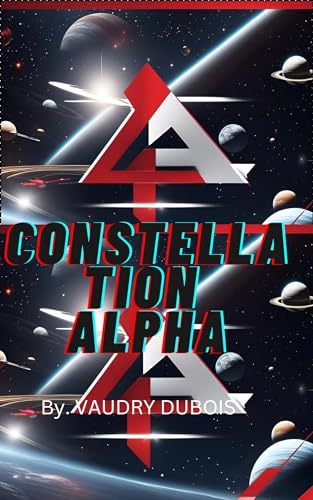
Constellation Alpha takes readers beyond Earth and into the vast unknown of space. Co-authored with Vaudry DuBois, this science fiction title expands Vaudry Tre's universe-building into new territory.
A collaborative work that brings together two creative voices, Constellation Alpha is for readers who love sci-fi that asks big questions about humanity's place among the stars.
Get notified when new books drop. No spam, just releases.
First Chapter Preview
Constellation Alpha
In the fourteenth year of the Constellation Program, Commander Elena Vasquez made the mistake of looking out the viewport before her morning coffee.
The viewport was regulation size — forty centimeters by sixty, double-layered borosilicate glass with a thermal coating that made the stars look slightly warmer than they were. In the early days of the mission, crew members had pressed their faces to it constantly, fogging the glass and leaving forehead prints that the ship's cleaning system removed every eight hours. By year nine, most of them had stopped looking altogether. The stars stayed the same. The distance stayed the same. Looking didn't help.
Elena looked anyway.
This morning, something was different.
She'd noticed it before her conscious mind caught up to the noticing — a wrongness in the composition of the view, the way a word can suddenly look misspelled even though you've read it a thousand times. She leaned closer to the glass, her coffee forgotten on the console beside her.
The pattern was wrong.
She'd memorized the star maps in year one, back when memorizing star maps still felt like a meaningful thing to do. Orion's belt offset by six degrees — they'd been traveling long enough that Earth's constellations had begun to lose their shapes. Polaris was no longer north. The Southern Cross had drifted into meaninglessness. Navigation was done by computer, not by eye, but Elena kept the maps in her head anyway, out of stubbornness or habit or the particular superstition that understanding where you are protects you from getting truly lost.
The pattern was wrong.
Not differently wrong than yesterday. Not wrong in the way that years of travel had made it wrong. Wrong in a new way. A sudden way. Two stars in the mid-field of her view that she had catalogued as background objects — dimmer than navigation stars, unremarkable, irrelevant — had moved.
Stars don't move. Not on a human timescale. Not visibly.
Elena picked up her comm unit and called Dr. Osei.
He answered on the third ring, voice rough with sleep. "It's 0500."
"I need you at the observation deck."
A pause. "Vasquez."
"Now, please."
He was there in four minutes, still wearing the oversized University of Lagos sweatshirt he'd had since before the launch, the one with the small ink stain on the left cuff shaped like a comet. He came to stand beside her at the viewport. She said nothing. She pointed.
He looked.
He looked for a long time.
"Those are the Gamma-cluster objects," he said finally. "EC-7729 and EC-7730."
"Yes."
"They were 0.4 arc-degrees apart at last mapping."
"Yes."
"They're not 0.4 arc-degrees apart now."
"No," Elena said. "They're not."
Another silence. Outside the glass, the two lights that were not background objects and were not stars held their new positions with what Elena could only describe, irrationally, as intention.
"How long since last mapping?" she asked.
Osei checked his tablet. His face did something she recognized — the expression of a man whose model of the universe was having a very bad morning.
"Fourteen hours," he said.
Elena nodded. She'd expected that.
What she hadn't expected — what kept her standing at the viewport as the rest of the ship slept and the distance between the lights continued, slowly and certainly, to close — was what came through the ship's communications array at 0513.
Not static.
Not interference.
A pattern.
Repeating.